
Censoring Erotics, Censoring Community Art under Platform Surveillance
For almost a decade, SPUNK ROCK has created vivid erotic art filled with humour, colour, gender play, and unapologetic desire. Her illustrations center bodies and dynamics that mainstream erotic aesthetics often omit: fat bodies, queer desire, kink, femdom, and fluid attraction. These themes have earned her a devoted audience, but they have also placed her directly in the path of increasingly aggressive platform moderation systems. As part of Repro Uncensored’s research on digital suppression targeting queer expression, erotic artists, sex workers, and body positive creators, we spoke with artist Nellie about the forms of censorship she has faced, how it has shaped her practice, and what it means to sustain erotic art under algorithmic surveillance.
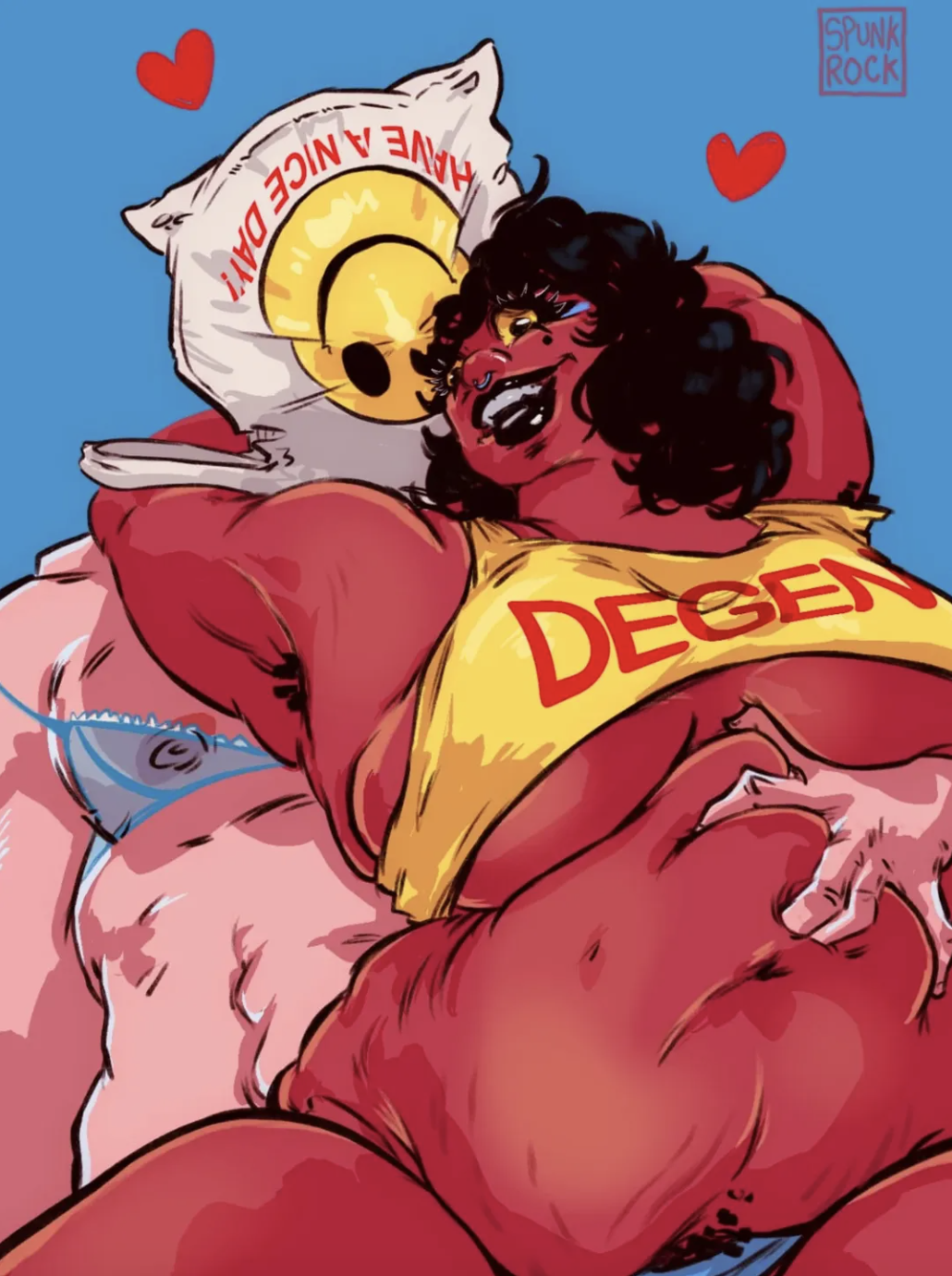
Art shaped by community and lived experience
Nellie describes her practice as deeply rooted in the communities that raised her. “I would not be the artist I am without sex work. I am also a big girl who fancies everyone, so I wanted to represent that,” she explains. Her depiction of queer, kinky and non-straight-sized bodies has built a mutual relationship. These communities embraced her work, and she draws inspiration from them in return. The loop is continuous and generative.
A long timeline of platform suppression
Censorship entered her life suddenly. In 2019, Instagram began removing her posts even though she had shared more graphic work for years without issue. Later that same year she lost her first account entirely. “The censorship back then was nothing compared to today. The moderation is quicker and more contradictory than ever.” Her experience now spans multiple platforms and multiple forms of intervention: nearly one thousand days banned from going live; a backup account deleted; her first account deactivated twice then permanently removed; her current account suspended on Christmas Eve before being restored; Twitter and TikTok accounts deleted; additional restrictions on Etsy and Bluesky. Her documentation echoes the patterns RU tracks across our incident reports. Moderation has become faster and harsher, appeal systems rarely work and the level of risk escalates for artists whose work centers eroticism, queerness or kink.
What platforms consistently remove
Although enforcement feels arbitrary, some visual elements in her work are consistently flagged. According to Nellie, the most reliably censored motifs include ball gags, any suggestion of penetration, oral positions, drool or bodily fluids, bare breasts and illustrations with more visible flesh. None of these depictions involve explicit nudity or pornographic detail. They are stylised illustrations, often humorous, always non graphic. Yet they are treated as violations. This reflects a broader systemic pattern. Automated moderation disproportionately targets erotic art, queer intimacy, fat bodies and BDSM aesthetics even when they comply with platform rules.
The pressure to self censor
Years of removals have reshaped her creative choices. “I do rethink what I create. My work has always been softcore. I have never depicted genitalia as a personal choice. The fact that my work is never that explicit makes censoring it even more tricky. I was never a hardcore sex artist, so having to tone it down even more dilutes the eroticism.” She describes an ongoing internal negotiation. She knows she can make work with more erotic charge, but visibility has become a form of survival. Remaining on the platform requires restraint, and restraint shapes the art itself. Commissions remain one of the few spaces where she can work freely.
The emotional and economic cost of erasure

Losing her first account was financially devastating. “It had seventy thousand followers and brilliant engagement that translated into reliable sales. I lost about a third to half of my income after that and I have not been able to get back to that salary since.” The emotional toll compounds the economic hit. “It makes me feel like a failure some days. I want people to feel seen in my work. Sometimes more inclusive pieces are the ones removed and I feel those losses harder because I know they could have made someone feel validated.” Her experience illustrates a key finding in RU’s research. When platforms censor erotic artists, they are not only suppressing visibility. They are disrupting livelihoods, disrupting communities and disrupting the ability of people to see their bodies represented with dignity and desire.
Looking forward
Despite years of surveillance, Nellie continues to create. She has turned toward traditional painting as a counter gesture to the rise of AI-generated erotics and continues to experiment with playful, sensual, community-centered imagery. “Any resistance encourages me to get better at my craft. Anyone who interacts with my work or pays me for it keeps me galvanised. It is my audience that gives me hope.” Her story reflects a broader collective reality. Erotic artists remain at the frontlines of digital censorship. Yet, they continue to create, rebuild, and sustain communities in spaces that were never designed to hold them.